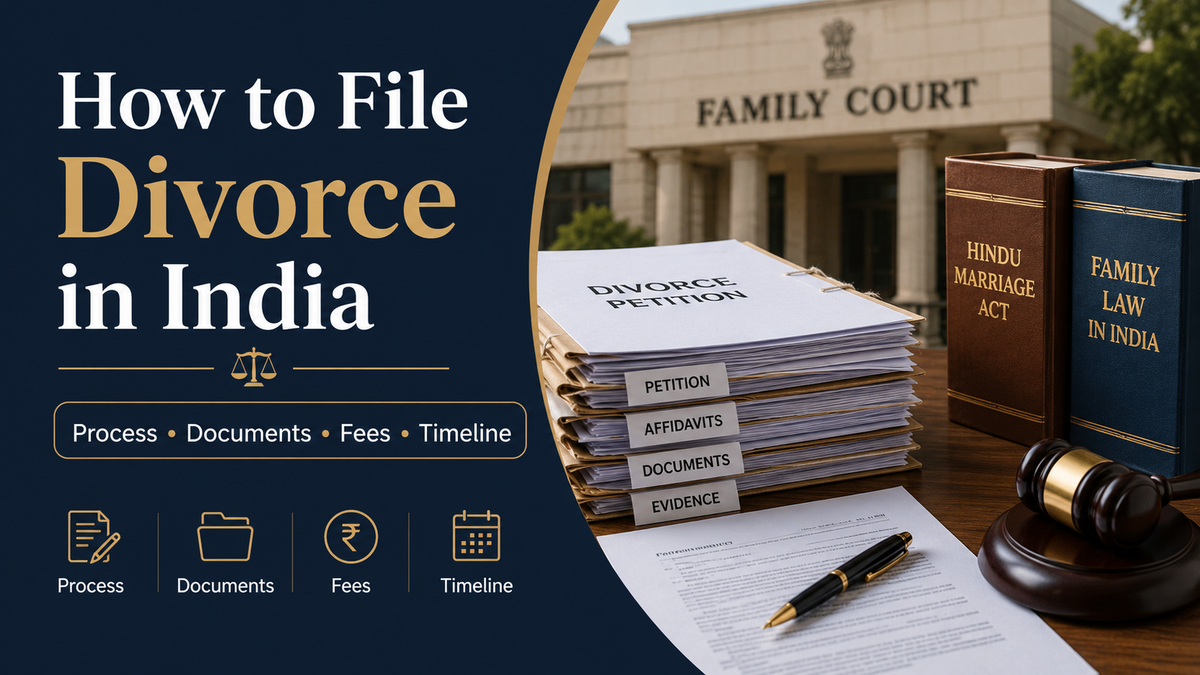
Filing for divorce in India is often more complicated than people initially expect. Apart from the legal procedure itself, couples usually have to deal with financial concerns, child custody arrangements, court appearances, maintenance claims, and uncertainty about how long the process may continue. Many people also struggle to understand the difference between mutual consent divorce and contested divorce, whether the case can be handled online, and what family court proceedings actually involve in practice.
A large amount of divorce-related information available online focuses only on legal provisions while ignoring the practical side of litigation. In reality, family court matters often involve repeated hearings, settlement discussions, procedural delays, and documentation issues that affect both parties over time. The experience also differs significantly depending on whether the spouses are cooperating, whether children are involved, and whether there are connected disputes relating to maintenance, domestic violence allegations, or property.
Understanding how the divorce process in India actually works helps people make more informed decisions early on. It also reduces common misunderstandings about timelines, legal costs, court procedure, and the practical realities of litigation. Whether someone is considering a mutual separation or preparing for a contested case, having a realistic understanding of the process usually makes the situation easier to navigate.
Divorce Laws in India: Understanding the Legal Framework
Divorce in India is governed by different personal laws depending on the religion under which the marriage was solemnised. Hindu couples are generally covered under the Hindu Marriage Act, while civil and interfaith marriages are usually governed by the Special Marriage Act. Christian, Muslim, and Parsi marriages follow separate legal frameworks as well.
Despite these differences, most divorce cases broadly fall into two categories:
- mutual divorce
- contested divorce
That distinction affects almost everything connected with the case — timelines, legal costs, emotional pressure, court involvement, and the overall complexity of proceedings.
For some couples, the separation itself is already mutually accepted and the focus shifts toward settlement discussions. In other situations, disputes become more adversarial because of allegations, financial disagreements, or disagreements involving children.
The legal process changes considerably depending on which category the case falls into.
What the Family Court Process Usually Looks Like
People who have never attended family court often expect dramatic courtroom arguments from the very beginning. In reality, most family court proceedings are procedural in the early stages.
The first few hearings commonly involve:
- filing scrutiny
- issuance of notice
- mediation referrals
- counselling sessions
- procedural formalities
Many litigants are surprised by how much waiting is involved. It is not unusual for parties to spend several hours at court for a hearing that lasts only a few minutes. Family courts also tend to encourage settlement efforts before allowing disputes to become fully adversarial.
That process can feel frustrating, especially when the situation already feels emotionally urgent to the people involved.
In practice, divorce litigation is rarely only about legal provisions. Financial uncertainty, communication breakdown, family pressure, parenting concerns, and procedural delays often become equally significant parts of the experience.
Mutual Divorce: Simpler, But Not Always Easy
For many couples, mutual consent divorce feels more manageable because both spouses already agree that the marriage should end. Under Hindu law, this process is commonly filed under Section 13B of the Hindu Marriage Act.
Even then, settlement discussions are not always straightforward.
A mutual divorce usually requires agreement on issues such as:
- alimony or maintenance
- child custody and visitation
- financial settlement
- property arrangements
- withdrawal of related legal complaints, where applicable
This is often where complications begin.
Couples may agree in principle about separation but disagree sharply about timelines, financial terms, school expenses for children, or future responsibilities. Some settlements break down unexpectedly after the paperwork stage begins because details were never properly discussed earlier.
Lawyers handling family disputes see this regularly.
The First Motion Stage
Once settlement terms are broadly finalised, both spouses jointly file the divorce petition before the family court. The court generally records statements confirming that:
- both parties are consenting voluntarily
- reconciliation is unlikely
- settlement terms are understood
Contrary to popular assumptions, these hearings are usually calm and procedural rather than confrontational.
Are you a lawyer? Grow your practice.
For many people, the emotional difficulty comes less from speaking in court and more from the fact that the separation has now formally entered the legal process.
Understanding the Cooling-Off Period
After the first motion stage, the law traditionally provides a six-month cooling-off period before the second motion hearing.
This creates a lot of confusion online.
Some people believe every mutual divorce must take exactly six months. Others assume the waiting period can always be waived immediately. Neither assumption is completely accurate.
Courts do have the power to waive the cooling-off period in appropriate situations, particularly where:
- the parties have already lived separately for a long time
- settlement issues are resolved
- reconciliation is clearly unlikely
However, waiver depends on the facts of the case and the court’s discretion.
Another point people often overlook is that mutual consent must continue until the final decree is granted. If one spouse withdraws consent before the second motion stage is completed, the petition itself can fail.
That is one reason experienced lawyers usually advise careful settlement drafting before filing.
Contested Divorce: When Litigation Becomes More Difficult
A contested divorce begins when one spouse wants divorce but the other opposes it, or when serious allegations make settlement difficult.
Under Indian law, contested divorce may be filed on grounds such as:
- cruelty
- adultery
- desertion
- conversion
- mental disorder in legally recognised situations
In practice, cruelty — especially mental cruelty — is among the most commonly used grounds in family courts.
Contested litigation changes the tone of the dispute very quickly. Once allegations enter the case, proceedings often expand beyond divorce itself and begin involving:
- maintenance and custody
- residence rights
- domestic violence allegations
- financial disclosure disputes
- visitation issues
- interim applications
Some cases that initially appear manageable become significantly more hostile once financial negotiations fail.
Mediation and Counselling
Many litigants feel confused when courts refer them to mediation. Some assume the judge is refusing divorce or forcing reconciliation.
Usually, that is not the case.
Family courts are expected to explore settlement possibilities before litigation becomes fully adversarial. In some matters, mediation genuinely helps. In others, it simply clarifies how far apart the parties already are on financial or parenting issues.
Even relatively civil couples often find mediation emotionally uncomfortable because discussions become personal very quickly.
Evidence and Procedural Delays
This is where contested cases often become lengthy.
Courts may examine:
- financial records
- electronic communication
- medical documents
- witness testimony
Are you a lawyer? Grow your practice.
- travel history
- bank statements
One common misunderstanding is that screenshots or isolated messages automatically prove allegations. Courts generally examine context, chronology, authenticity, and consistency before relying heavily on electronic evidence.
People also underestimate how much procedure affects timelines. Missing documents, repeated adjournments, overloaded court schedules, and incomplete filings are major reasons divorce litigation becomes prolonged.
What Documents Are Usually Needed Before Filing for Divorce?
The exact paperwork depends on the nature of the case, but divorce petitions commonly require:
- marriage certificate
- identity proof
- address proof
- passport-size photographs
- wedding photographs
- income documents
- bank statements
- proof relating to children or separation
In contested matters, additional material such as WhatsApp chats, emails, recordings, medical records, or financial documents may also become relevant.
Documentation tends to become especially important once disputes involving income, maintenance, or custody begin. Poor record keeping creates avoidable complications later.
How Much Does Divorce Actually Cost in India?
There is no fixed national cost for divorce in India. Expenses vary significantly depending on:
- city
- lawyer experience
- complexity of disputes
- number of hearings
- duration of litigation
- connected proceedings
A mutual divorce is generally less expensive because fewer hearings and procedural stages are involved. Contested litigation, however, often becomes more expensive over time due to repeated appearances, interim applications, evidence stages, and connected disputes.
One practical reality many people realise late is that prolonged hostility usually increases legal costs considerably.
How Long Does Divorce Take in India?
This is one of the most common questions people ask, and also one of the hardest to answer precisely.
A realistic estimate usually looks like this:
| Type of Divorce | Approximate Timeline |
|---|---|
| Mutual consent divorce | 6 to 18 months |
| Mutual divorce with waiver | Sometimes shorter |
| Contested divorce | Several years in many cases |
The timeline depends on:
- cooperation between spouses
- court workload
- maintenance disputes
- child custody litigation
- mediation outcomes
- evidence complexity
- procedural delays
Even experienced lawyers are often cautious about giving exact timeline predictions because family litigation rarely moves uniformly.
Can Divorce Be Filed Online in India?
Searches relating to online divorce process have increased sharply in recent years, partly because many people assume the entire procedure can happen digitally.
Are you a lawyer? Grow your practice.
The reality is more limited.
Some courts now allow:
- partial e-filing
- online case tracking
- virtual hearings in limited situations
However, most divorce matters still require physical appearances during important stages, especially for:
- statement recording
- mediation
- evidence
- final hearings
Advertisements promising “instant online divorce” often create unrealistic expectations about how family court procedure actually works in India.
Rights of Husband and Wife During Divorce Proceedings
Both spouses have legal rights during divorce proceedings, although the exact nature of those rights depends on the facts of the case.
Issues commonly considered by courts include:
- maintenance rights
- child custody and visitation
- financial disclosure
- residence rights
- protection from harassment
- parenting responsibilities
In custody disputes particularly, courts usually focus more on the welfare and stability of the child than on emotional allegations made by either parent.
That practical distinction becomes important in many family court disputes.
Common Mistakes People Make During Divorce Cases
Some mistakes appear repeatedly in family litigation.
One is assuming mutual consent divorce is automatically simple. Even cooperative cases require properly drafted settlement terms and continued agreement until the final decree stage.
Another common mistake is relying entirely on verbal assurances during settlement discussions. Lawyers generally advise documenting financial and custody terms clearly instead of depending on informal understandings.
People also frequently underestimate the emotional impact of prolonged litigation. Repeated hearings, delays, financial pressure, and communication breakdown can become mentally exhausting over time.
Children are sometimes drawn unnecessarily into disputes as well, which often worsens both the legal conflict and the emotional environment around the case.
Practical Legal Advice Before Taking the Next Step
People considering divorce are often emotionally overwhelmed, which is understandable. Still, a few practical steps early in the process usually help significantly:
- organise financial records carefully
- preserve important communication
- avoid impulsive allegations
- understand settlement terms before signing
- focus on long-term practical outcomes rather than short-term anger
The legal process becomes far more difficult when emotions completely control decision-making.
Experienced family lawyers see this repeatedly, particularly in cases where communication between spouses has already broken down long before litigation begins.
Good legal advice is not only about filing petitions or attending hearings. It is also about helping people understand the practical consequences of decisions that may affect finances, parenting, and future stability for years afterward.
A Final Word Before Moving Forward
Divorce is not only a legal process. It affects finances, parenting arrangements, living situations, and long-term planning at the same time. Some couples manage the process respectfully through settlement and mutual divorce. Others go through prolonged contested litigation involving maintenance disputes, custody issues, and years of hearings.
No two cases unfold in exactly the same way.
What generally helps most is realistic legal guidance early in the process. Understanding what family court proceedings actually involve — rather than relying only on simplified online summaries — usually allows people to make more informed decisions during a difficult phase of life.
Speaking with an experienced divorce lawyer can help you understand the most practical legal approach for your specific situation, especially when children, financial dependency, or contested allegations are involved.